The Real Price of Travel Baseball: From Family Finances to Player Fatigue
By: Ethan Penrod
Story Highlights
- Rising costs in youth travel baseball are forcing some families to spend between $3,000 and $7,000 a year, according to research published by the National Council of Youth Sports.
- Year-round schedules are contributing to an increase in overuse injuries, according to Dr. Joel S. Brenner of the American Academy of Pediatrics noting that overtraining is now among the leading causes of youth sport injuries.
- “It's this arms race amongst parents and their kids to make sure their kids are getting the best experience possible and the most opportunities possible,” President of San Carlos Little League President Jeff Rosa said. “Everything keeps ratcheting up, and I think it's because people don’t want to be left behind.”
SAN DIEGO — Youth baseball started as a fun, community-based pastime, but it has evolved into a competitive, high-pressure machine. Youth travel baseball has exploded in popularity, promising elite talent and college exposure. But parents, coaches, and experts say the cost – physically and mentally – is taking a toll.
“It's this arms race amongst parents and their kids to make sure their kids are getting the best experience possible and the most opportunities possible,” President of San Carlos Little League President Jeff Rosa said. “Everything keeps ratcheting up, and I think it's because people don’t want to be left behind.”
Travel baseball differs from Little League by fostering a more competitive environment with higher commitment levels. The ultimate goal for travel baseball is to increase exposure for youth; meanwhile, Little League’s emphasis is on participation and the game itself.
The thriving travel-sports sector mirrors a bigger shift in American youth athletics: a transition to privatized, pay-to-play systems that prioritize elite competitiveness over accessibility and enjoyment. In San Diego alone, there are 14 Little League organizations, and there are around a dozen youth travel baseball organizations, reflecting how deep the culture of competitive youth sports has taken root across the region.
As shown in the infographic below, youth travel baseball made its first appearance back in the early 1980s, with youth teams from different states traveling in search of better competition. Fast-forward to the early 2000s, and travel baseball had surpassed high school baseball in terms of collegiate recruitment. Now, travel baseball has become the widely accepted option for youth wanting to play in a relatively competitive environment.
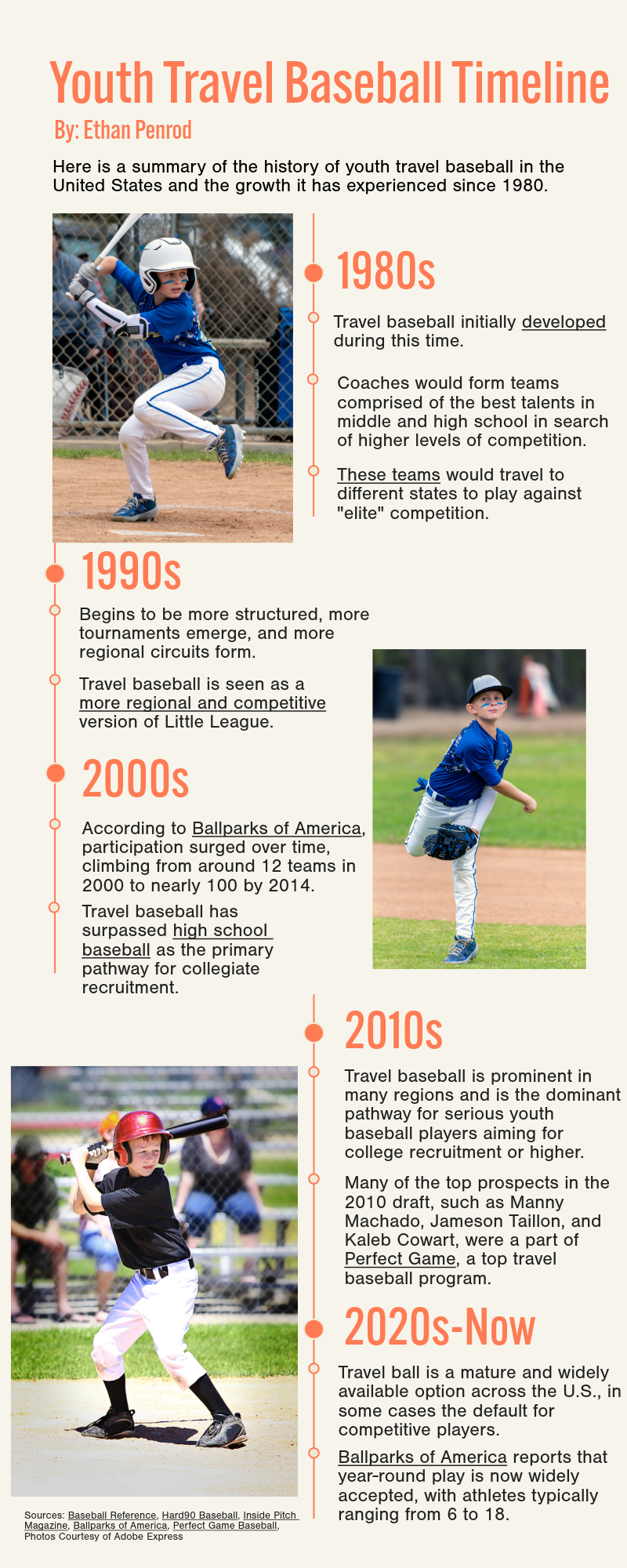
The Steep Costs of Chasing a Dream
Some families across the country are investing thousands of dollars a year into their children’s travel baseball dreams. The National Council of Youth Sports, an organization that promotes the safety and health of youth sports, reports that parents spend between $3,000 and $7,000 annually, with some families paying more than 10% of their income on tournament fees, equipment, and travel expenses. This research, published by the NCYS website by Alexandria Chrumka, MD, and Joseph Guettler, MD, highlights the growing financial burden that youth travel sports can place on families.
High costs such as these create a pay-to-play environment, where access to elite opportunities often depends on a family’s financial capabilities. Not all families can afford to fund such high expenses, leaving a widening gap between those able to compete at higher levels. This may result in young players missing out on exposure and development.
Even for families who can afford it, the pressure to keep up can be strong, resulting in long road trips, expensive hotel accommodations, and lost family time. A parent survey in 2023 conducted by Bat Digest, a site that provides reviews and rankings of baseball and fastpitch softball bats, indicated that many families pay up to $10,000 per season just for travel baseball, not adding training camps and private lessons.
“The time is obviously a huge commitment,” said Little League and travel baseball parent Jason Maxwell. “It does get in the way of family aspirations, and sometimes you find yourself planning trips around your baseball schedule.”
Rising Overuse Injuries in Youth Baseball
The desire to play year-round, often starting as early as age 8, is leading to an increase in injuries among young athletes. According to an American Academy of Pediatrics report by Joel S. Brenner, MD, MPH, overuse injuries and overtraining are now some of the leading causes of sports-related harm in youth.
“Anytime you do something more, you’re always going to have an increase of risk of injury,” said Washington Nationals Minor League Strength and Conditioning Coach R.J. Guyer. “Like with anything, I don’t think it (youth travel baseball) is gonna go away. So knowing that it’s not gonna go away, I would want to look at how to best do it (training).
For Guyer, his goal is to retain athleticism within those who specialize in year-round baseball. Training like a football, soccer, or basketball player is high on Guyer’s priority list.
“I don’t need to get them stronger in movements they are already doing,” Guyer said. “I need them to get stronger and more athletic in other ranges of motion.”
For baseball players, this frequently results in elbow and shoulder injuries due to excessive pitching and little rest. The MomsTeam Institute of Youth Sports Safety, an organization that aims to provide a safer environment to youth athletes through education, estimates that half of all youth sports injuries are avoidable, particularly those related to repeated action and inadequate recovery time.
Guyer said that children who are less interested in playing baseball at a younger age may have more injuries.
“I have seen kids who are going through the motions because they don’t want to be there,” Guyer said. “You're going to be basically fatigued out where you’re not physically fatigued, you’re mentally fatigued. With that, you are gonna start not moving as well, and you’re very well likely to break down mechanics, and now that’s what’s going to start leading to injury.”
Burnout Before High School
Arguably, the biggest thing for the youth participating in year-round play is the lack of passion and early specialization. There are many instances of parents wanting their children to play baseball more than the children themselves do. The pressures from both parents and performance can ultimately lead to the phenomenon of burnout by the time players get to high school.
“The pressure to perform, and the pressure to go out there and pitch in multiple games in one day, or the tournament aspect of things, I’m not a fan of that,” Rosa said. “If you start looking at yourself as an 8- or 9-year-old and saying, I’m not as good, I think that could put pressure on kids, whereas in Little League, maybe not so much.”
Interestingly enough, Guyer made the connection to burnout and injuries. He said that the lack of desire to play is where more injuries can occur.
“If you have the athlete or the kid that’s forced into early specialization and they’re like, ‘hey, I want to play basketball,’ and the parents say you can’t do that, that I think is going to burn the kid out,” Guyer said. “I think there is going to be a lot more injuries. Not wanting to do it (play baseball), that’s going to lay into more injuries.”
Guyer added that the time for specialization is during a player’s sophomore or junior year of high school. But even when baseball becomes the priority, Guyer emphasizes the importance of playing multiple sports recreationally to retain athleticism and to give the body and mind a break.
The most important factor, Guyer emphasized, is that the desire to play must come from the child. There needs to be a genuine interest before a parent encourages specialization. For families deciding whether to join a travel team, it should be the child’s enthusiasm driving that choice. Likewise, if a child expresses a need to step back or wants to pivot to a different sport, parents should respect that decision.
Finding Balance in the Future of Youth Baseball
Travel baseball is here to stay, offering many people opportunities, discipline, and a sense of community. However, as the cost of competition grows, so will the consequences.
Baseball has always been about enjoyment, teamwork, and community. For the next generation to love the game, parents may need to take a step back and realize what kid sports are all about: having fun.
“At eight or nine, you get plenty of baseball in the recreation world,” Rosa said. “You should be pursuing other things with your kids, too. Why would you put all your eggs in one basket?